
[The last renewal of this page: January 28, 1999]
1. The True Nature of the Leonid Meteor Shower The comets consist of dust and ice, different from the planets. As it
goes in its orbits, they scatter their dust along with their orbits.
As they are repeated many times, the dust and ice being scattered make
a swarm and goes all along the orbit. There exist many comets like this
in the Solar System, and some of these happened to have the orbit which
intercepts the orbit of the earth.
The true nature of the Leonid Meteors is the Tempel-Tuttle comet, which
revolves around the Sun with the 33year cycle. In the case of the year
1988, the comet itself intercepted the orbit of the earth in Feburary,
1988 already, and when the earth reaches the intercept point to their
orbit on Nov.18, we will meet the newest and heaviest dust which has
been scattered from the comet a half year ago. This is the reason why
the Meteor Shower is expected. (Every year, when the earth arrives at
the intercept point, the meteor swarm is observed, but every 33 years,
after the comet arrives at the intercept point, and leaves haevy dust
on its orbit, the meteor shower is observed.)
By the way, it is not called "Leonid Meteors" as the meteors arrived
from the Constellation of Leonid, but when the earth arrives at the
intercept point in its revolutional orbit, the constellation of Leonid
stays as a backgourd to the direction to the orbit of the Tempel-Tuttle
comet.
The oldest record of the Leonid Meteors is in the year 902 in Arabia,
and 967 in Japan. The scientific records starts in 1799. There is a
note written by well-known explorer Mr.Funbort in 1799 in Venezuela. It
says "Bright meteors cover all of the sky, and there was not left any
space larger than three times as large as the moon without meteors."
In 1833, Nov.12, the meteor shower was observed in the U.S.A..
Professor Olmstead of University of Wales wrote "Unbelievable numbers of
Fireballs are observed like sparking continuous radiation. It was as
beautiful as have the people in the bed waked up." The story that the
800 farmers who faced to this meteors screamed "The earth burns!" and
prostrated themselves on the groud praying the God, is well known, and
there left woodblock prints on that later.
When it falls in the atmosphere as a meteor, it speed reaches to
100,000Km/h, and is 100 times as fast as the Jumbo Jet.
The altitude of the meteor is luminous, is 50Km to 100Km above the
ground. That is higher than the altitude of the Jumbo Jet's cruising
(10Km), but much lower than the altitude of the Space-shuttle. (500Km)
(There are some fall down to much lowere as a fireball, and also reach
to the ground as meteorites as a result of no completion of burning.
It is expected 50 to 200 meteors in every hour are expected. It is
said that there is a possiblity to see more than 1,000. (1 meteor in
every 3 seconds!)
In 1966, the period in which more than 1,000 meteors were observed
continued for 40 minutes. So, it is important to meet the peaks time.
The best possibility is given at the time when the earth arrives at the
intercept point to the Tempel-Tuttle comet, which is at Sun longitude
235.258degrees, which is at 04:30AM on Nov.18 in Japan Standard Time.
(19:30UTC on Nov.17) Radiant point will be at almost the East and 60
degrees of elevation angle.(Top of the sky is 90degrees) It is expected
that the meteors will be spread out to the East half of the sky from the
radiant point.
05:30 AM is the time in Japan for the sky to start to get bright. So, if
the peaks will be shifted ahead, the observation at its peaks will be
difficult in Japan. The area in which the sky is dark and the radiant
point is high enough at that moment is Northeast Area of P.R.China.
This time, in Europe and America, there is very little possiblity to
meet the peaks. So, Japan is one of the country to get advantage over
rest part of the world. (Fortunately, the moon is almost new, and no
moon light will bother us!)
There will be some meteors more than magnitude of 2.0 which are visible
even in the bright sky in the cities. If the sky is dark enough to see
the stars of magnitude of 4.0 in suburban area, remarkable improvement
of the numbers of the visible meteors will be noted.(Maybe 10 time as
many as in the city sky.)
If you have a clock drives & equatorial mounting (Follow to the sky
movement by CPU and electric motors.), that sure is the best things to
use, but you can enjoy taking photographs without it.
Set the camera on the tripod. Use shutter releasing wire as it can
avoid undesired shock to the camera and it can lock the shutter released
for desired time. Set the camera to the East, looking up 60 degrees in
elevation.
Bright lens (Smaller value in F) is desired. Wide angle (Shorter m/m)
is fine. (Example : F=1.0 f=24mm)
Films which have higher sensitivity is better, but if you have somewhat
bright sky, higher sensitivity forth you to shorten the maximun exposure
time.
For the case that the lens get get fogged due to the coldness of the
night, you should put a kind of a portable hand warmer around the lens
tube of he camera with plastic tape or a string.
By reducing the exposure time within 45 seconds, the stars would not
draw lines as much as to be worries about, however, you will loose
chances to meet more meteors. If the sky is dark enough, it is also a
good idea to explose for about 5 minutes, accepting the stars will draw
lines to caputure more Meteors. (If you do this under a bright sky,
you'll get white pictures with very few stars and meteors.)
If you have a luck to see a fireball,or bright clund after the meteors,
you'd better repeat to give about 10 second exposures manytimes.
On November the 18th, the weather was fine, and we went to a montain
1,000m(3,000feet) high above the sea level at the back of the Naguri
Village in Saitama prefecture. (I went with Minol and Koyama-san, who
always write messages in MAFNET)
The comets consist of dust and ice, different from the planets. As it
goes in its orbits, they scatter their dust along with their orbits.
As they are repeated many times, the dust and ice being scattered make
a swarm and goes all along the orbit. There exist many comets like this
in the Solar System, and some of these happened to have the orbit which
intercepts the orbit of the earth.
The true nature of the Leonid Meteors is the Tempel-Tuttle comet, which
revolves around the Sun with the 33year cycle. In the case of the year
1988, the comet itself intercepted the orbit of the earth in Feburary,
1988 already, and when the earth reaches the intercept point to their
orbit on Nov.18, we will meet the newest and heaviest dust which has
been scattered from the comet a half year ago. This is the reason why
the Meteor Shower is expected. (Every year, when the earth arrives at
the intercept point, the meteor swarm is observed, but every 33 years,
after the comet arrives at the intercept point, and leaves haevy dust
on its orbit, the meteor shower is observed.)
By the way, it is not called "Leonid Meteors" as the meteors arrived
from the Constellation of Leonid, but when the earth arrives at the
intercept point in its revolutional orbit, the constellation of Leonid
stays as a backgourd to the direction to the orbit of the Tempel-Tuttle
comet.
The oldest record of the Leonid Meteors is in the year 902 in Arabia,
and 967 in Japan. The scientific records starts in 1799. There is a
note written by well-known explorer Mr.Funbort in 1799 in Venezuela. It
says "Bright meteors cover all of the sky, and there was not left any
space larger than three times as large as the moon without meteors."
In 1833, Nov.12, the meteor shower was observed in the U.S.A..
Professor Olmstead of University of Wales wrote "Unbelievable numbers of
Fireballs are observed like sparking continuous radiation. It was as
beautiful as have the people in the bed waked up." The story that the
800 farmers who faced to this meteors screamed "The earth burns!" and
prostrated themselves on the groud praying the God, is well known, and
there left woodblock prints on that later.
When it falls in the atmosphere as a meteor, it speed reaches to
100,000Km/h, and is 100 times as fast as the Jumbo Jet.
The altitude of the meteor is luminous, is 50Km to 100Km above the
ground. That is higher than the altitude of the Jumbo Jet's cruising
(10Km), but much lower than the altitude of the Space-shuttle. (500Km)
(There are some fall down to much lowere as a fireball, and also reach
to the ground as meteorites as a result of no completion of burning.
It is expected 50 to 200 meteors in every hour are expected. It is
said that there is a possiblity to see more than 1,000. (1 meteor in
every 3 seconds!)
In 1966, the period in which more than 1,000 meteors were observed
continued for 40 minutes. So, it is important to meet the peaks time.
The best possibility is given at the time when the earth arrives at the
intercept point to the Tempel-Tuttle comet, which is at Sun longitude
235.258degrees, which is at 04:30AM on Nov.18 in Japan Standard Time.
(19:30UTC on Nov.17) Radiant point will be at almost the East and 60
degrees of elevation angle.(Top of the sky is 90degrees) It is expected
that the meteors will be spread out to the East half of the sky from the
radiant point.
05:30 AM is the time in Japan for the sky to start to get bright. So, if
the peaks will be shifted ahead, the observation at its peaks will be
difficult in Japan. The area in which the sky is dark and the radiant
point is high enough at that moment is Northeast Area of P.R.China.
This time, in Europe and America, there is very little possiblity to
meet the peaks. So, Japan is one of the country to get advantage over
rest part of the world. (Fortunately, the moon is almost new, and no
moon light will bother us!)
There will be some meteors more than magnitude of 2.0 which are visible
even in the bright sky in the cities. If the sky is dark enough to see
the stars of magnitude of 4.0 in suburban area, remarkable improvement
of the numbers of the visible meteors will be noted.(Maybe 10 time as
many as in the city sky.)
If you have a clock drives & equatorial mounting (Follow to the sky
movement by CPU and electric motors.), that sure is the best things to
use, but you can enjoy taking photographs without it.
Set the camera on the tripod. Use shutter releasing wire as it can
avoid undesired shock to the camera and it can lock the shutter released
for desired time. Set the camera to the East, looking up 60 degrees in
elevation.
Bright lens (Smaller value in F) is desired. Wide angle (Shorter m/m)
is fine. (Example : F=1.0 f=24mm)
Films which have higher sensitivity is better, but if you have somewhat
bright sky, higher sensitivity forth you to shorten the maximun exposure
time.
For the case that the lens get get fogged due to the coldness of the
night, you should put a kind of a portable hand warmer around the lens
tube of he camera with plastic tape or a string.
By reducing the exposure time within 45 seconds, the stars would not
draw lines as much as to be worries about, however, you will loose
chances to meet more meteors. If the sky is dark enough, it is also a
good idea to explose for about 5 minutes, accepting the stars will draw
lines to caputure more Meteors. (If you do this under a bright sky,
you'll get white pictures with very few stars and meteors.)
If you have a luck to see a fireball,or bright clund after the meteors,
you'd better repeat to give about 10 second exposures manytimes.
On November the 18th, the weather was fine, and we went to a montain
1,000m(3,000feet) high above the sea level at the back of the Naguri
Village in Saitama prefecture. (I went with Minol and Koyama-san, who
always write messages in MAFNET)


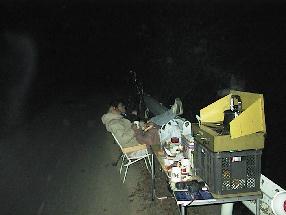

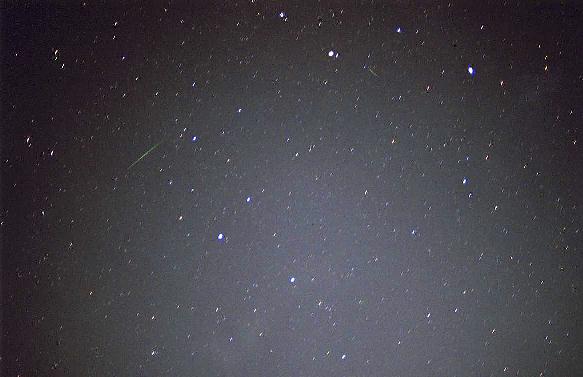
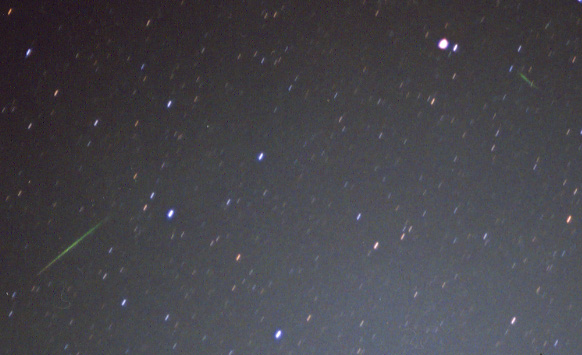
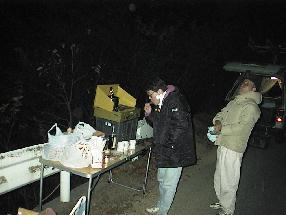 We stayed from 1:30Am to 5:30AM of 18th, but we could not see as much as
we expected. We saw about 50 meteors are coming for one hour at the peak.
However, Some of them were very bright, and a few of them had a fire-mark.
One came at 4:13 had a very bright fire-mark which lasted for more than
10 minutes. That one realy had a value to go there only for watching it.
Many meteors were visible out of the radiation point, and I could not get
them in my cameras. It was so sorry that I missed one at 04:13! Fotos
below are only pictures that I got meteors. They had a beautiful yellow
-green color.
We stayed from 1:30Am to 5:30AM of 18th, but we could not see as much as
we expected. We saw about 50 meteors are coming for one hour at the peak.
However, Some of them were very bright, and a few of them had a fire-mark.
One came at 4:13 had a very bright fire-mark which lasted for more than
10 minutes. That one realy had a value to go there only for watching it.
Many meteors were visible out of the radiation point, and I could not get
them in my cameras. It was so sorry that I missed one at 04:13! Fotos
below are only pictures that I got meteors. They had a beautiful yellow
-green color.
 Asia was where it predicted as the best pointo to observe, however, they
came to the earth 20 hours earlier than the prediction. That was in the
morning on 17th, and nobody could see them in Asia. Europe was lucky, and
they could happen to see more nearly 3,000 meteors in one hour there.
Asia was where it predicted as the best pointo to observe, however, they
came to the earth 20 hours earlier than the prediction. That was in the
morning on 17th, and nobody could see them in Asia. Europe was lucky, and
they could happen to see more nearly 3,000 meteors in one hour there.
 In case you hit this
page directly from a Search Engine, you can reach to all of the pages of MAFNET from Top Page
In case you hit this
page directly from a Search Engine, you can reach to all of the pages of MAFNET from Top Page