Comparison of Planets of Solar System

[The last renewal of this page: April 18, 1999]
 Distance from the Sun (Earth=1)
| Sun |
Mercury |
Venus |
Earth |
Mars |
Jupiter |
Saturn |
Uranus |
Neptune |
Pluto |
| - |
0.387 |
0.723 |
1 |
1.523 |
5.202 |
9.555 |
19.218 |
30.110 |
39.540 |
The distance from the Sun to the Earth(149,597,870,000Km) is calld "1 AU" in astronomy. The farest
planet, Pluto stays at 39.54AU, and is 5trillion 915billion Kilometers away.
Radiation from the Sun (Earth=1)
| Sun |
Mercury |
Venus |
Earth |
Mars |
Jupiter |
Saturn |
Uranus |
Neptune |
Pluto |
| - |
6.6769 |
1.9130 |
1 |
0.4311 |
0.0370 |
0.0110 |
0.0027 |
0.0011 |
0.0006 |
The light and heat radiation from the Sun decrease in inverse propotion to the square 2 of the
distance from the Sun.
Surface Temprature (in Centigrade)
| Sun |
Mercury |
Venus |
Earth |
Mars |
Jupiter |
Saturn |
Uranus |
Neptune |
Pluto |
| . |
-170/430 |
450 |
15 |
-150/15 |
-150 |
-180 |
-210 |
-220 |
-240 |
As a result, the Pluto, the farest planet from the Sun has only -240 degrees. The Mercury does
not have an atmosphere, and the temprature varies for 600degrees between day and night.
Diameter (Earth=1)
| Sun |
Mercury |
Venus |
Earth |
Mars |
Jupiter |
Saturn |
Uranus |
Neptune |
Pluto |
| 109 |
0.383 |
0.949 |
1 |
0.533 |
11.209 |
9.449 |
4.007 |
3.883 |
0.178 |
The largest planet in the Solar System is the Jupiter, and is 11 times as large as the Earth.
Mass (Earth=1)
| Sun |
Mercury |
Venus |
Earth |
Mars |
Jupiter |
Saturn |
Uranus |
Neptune |
Pluto |
| 332946 |
0.055 |
0.815 |
1 |
0.107 |
317.830 |
95.160 |
14.540 |
17.150 |
0.002 |
The Sun which has nuclear fusion activity has an extraordinary mass.
Density (Earth=1)
| Sun |
Mercury |
Venus |
Earth |
Mars |
Jupiter |
Saturn |
Uranus |
Neptune |
Pluto |
| 0.255 |
0.984 |
0.949 |
1 |
0.712 |
0.241 |
0.125 |
0.230 |
0.297 |
0.386 |
Although the Jupiter has a mass 318 times as large as the Earth, its density is only a quater of
the Earth. This means the Jupiter consists of light chemical elements (Hydrogen 88%). The Jupiter
is awful planet consisting of a liquid hydrogen, no having a firm ground like other planets. If the
Jupiter had a mass 100 times as much as it is, it could be another Sun as a result of nuclear fusion
activity.
Rotation Period (Earth=1)
| Sun |
Mercury |
Venus |
Earth |
Mars |
Jupiter |
Saturn |
Uranus |
Neptune |
Pluto |
| 25.449 |
58.809 |
243.678 |
1 |
1.029 |
0.415 |
0.445 |
0.720 |
0.673 |
6.404 |
While another Sun rise comes after the Sun rise on the Venus, about 244days will have passed on
the Earth.
Revolution Period (Earth=1)
| Sun |
Mercury |
Venus |
Earth |
Mars |
Jupiter |
Saturn |
Uranus |
Neptune |
Pluto |
| - |
0.241 |
0.613 |
1 |
1.881 |
11.862 |
29.458 |
84.022 |
164.774 |
247.796 |
While another Spring comes after the Spring on the Pluto, about 248 years will have passed on the Earth.
Tilt of Axis/Obliquity (degrees)
| Sun |
Mercury |
Venus |
Earth |
Mars |
Jupiter |
Saturn |
Uranus |
Neptune |
Pluto |
| 7.25 |
0.00 |
177.40 |
23.44 |
25.19 |
3.10 |
26.70 |
97.90 |
27.80 |
120.00 |
Earth rotates almost horizontaly tilting a little(23.44degrees), but the Uranus rotaes almost
verticaly falling over sideways.
Numbers of Satellites
| Sun |
Mercury |
Venus |
Earth |
Mars |
Jupiter |
Saturn |
Uranus |
Neptune |
Pluto |
| - |
0 |
0 |
1 |
2 |
16 |
18 |
15 |
8 |
1 |
With many planet-surveyers, a lot of new satellites have been discovered. The pluto has a satellite
named Charon, which diameter(1,270Km) is almost a half of the Pluto(2,320Km).
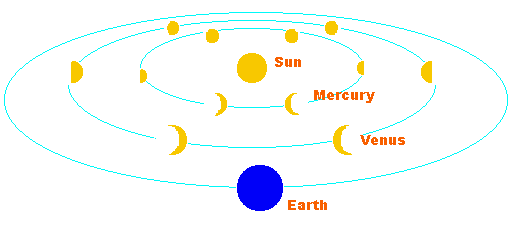
The Mercury and Venus are revolving in the orbits inner than the Earth, and therefore, depending relative
position from the Earth, they wax and wan like the moon.
 In case you hit this
page directly from a Search Engine, you can reach to all of the pages of MAFNET from Top Page
In case you hit this
page directly from a Search Engine, you can reach to all of the pages of MAFNET from Top Page