My First Flight on Boeing747-400
- May 28, 1998 -

[The last renewal of this page: June 8, 1998]
1. My dream, Flying BOEING747-400
I got a chance to fly real Jumbo Jet! Well, it's real, but it's a Flight
Simulator.(Hi) But, the Flight Simulator of Jumbo Jet costs 20million US
Dollars, and all the parts in there are the same as in a real Jumbo, even
a screw. It needs excatly the same operations as for a real Jumbo, and it
reacts exactly the same as a real one. These Flight Simulators are used
for periodical trainings or examinations for real pilots of each airline
company. They can reproduce any weather conditions and flight conditions,
and is very useful to realize training under conditions which are very
difficult to practice in a real world.
The simulator is mounted on strong oil driven cylinders, and moves, leans
and dash straight to a certain direction. (Of course, you should be out-
side of the Simulator to see it.) In you are inside of the Simulator, you
would feel vaibrations, soud and movement of gravity just as if you were
on real Jumbo Jet. (If you need medicine to prevent airsick, you need it
in the Simulator.) You would be just surprised to feel so real if you get
on it. (If you shut your eyes, it's so hard to tell wether if you are on
the Simulator or real Jumbo.)
Each airline campany has this kind of Simulators in their training facili-
ties utilizing them for daily trainings, periodic technical examninations
and promote examinations. This time, I had an opotunity to try the Boeing
747-400(the newest model of Jumbo) Filight Simulator at my admirative air-
line company, Japan Airline (JAL).
You would imagine how much I was excited with this opportunity, if you
know that I have been dedicated myself with the Microsoft PC-Flight Simu-
lator everyday, and I only have an experience of flying Cesna(Real one!) a
year ago. Anyway, it is exactly the same as real Jumbo whatever you may
do, except that it won't take your life away.
I was noticed that the aircraft that I will fly would be the Boeing 747-
400 about two weeks before the scheduled day, and the news made me so
excited and I heard my heart pounding. The type 400 is the newest and
most computalized type of Jumbo which eliminates mechanical instruments as
many as possible, with six multi-function color displays mounted, to
enable two men crue control. Ten years ago, when I had a chance to visit
JAL as a menber of observation group on business to get on another Flight
Simulator of JAL(Just for about ten minutes, though),it was also Jumbo,
but was older dash 300(747-300). Anyway, at that time, I was not crazy
about airplane as now, and had very little knowledge and experience(?),
and now I am always thinking that it was such a wasting for me at that
time. So, this was a great chance for me to get recover everything.
I have been well prepared with hard studies and practices for flying air-
plane with Microsoft PC-Flight Simulator, and my first experience of fly-
ing Cesna last year. The day, May 28th 1998 has come after spending hard
time to get asleep for many nights.
2. Meet with Flight Simulator BOEING747-400
As we visited a training facility of JAL in Haneda at scheduled eight
O'clock and call on the Captain "H" who had promised me to give me a
lesson, he was still on duty on the groud, giving an evaluetion for the
examination for Co-pilots. I understood practical examination (Flying
test) using Flight Simulators had been just finished, and that made me
feel tense both physically and emotionally. I understood he would give
me a special lesson after his regular duty, and I started to worry about
if the captain was unhappy to do extra work and sent me packing after just
about ten minutes lesson. Anyway, we got in the Similator waiting for
him to appear. Oh! Yeah!....There it is! Wonderful! Huge! As we got
in a big room in which two Simulators were placed, and went down the
stairway, two huge white colored bodies were set there. I found sevral
blocks were mounted on the top of the Simulator, and understood they were
video projectors to privide multiscreen panorama outside view system.
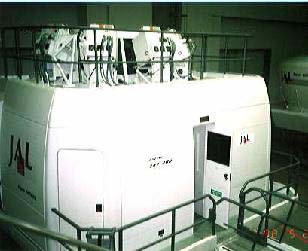
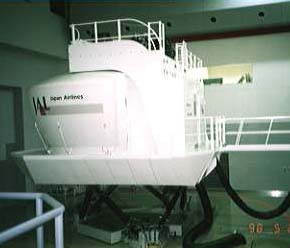
BOEING747-400 Similator BOEING737 Simulator
Mr.O who is guiding for us today explained me that the one over here is
the 747-400 and the other one over there is the 737. Now we tried to get
enter the 747-400.

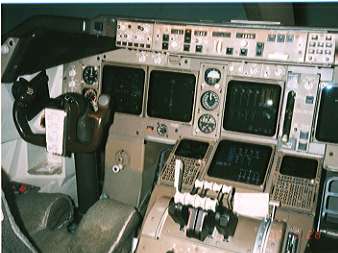

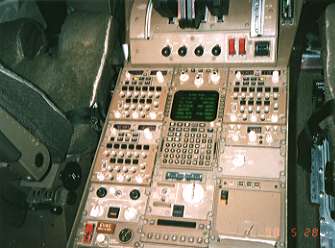
Oh! There it is!......Yeah, this one! There was the same thing as I ha-
ppened to see before on ANA(All Nippon Airways) Boeing 747-400. I was
the on board Boeing 747-400 from Tokyo to Fukuoka on business, and as I
asked such a many questions to the Captain through stewardess, finally the
Captain ordered me to show up the cokpit after landing at destination air-
port. I visted the cockpit worrying that he might be unhappy as I had
disturbed his pilot, however, he was so happy and let me sit on the
Captainseat! Well now, I am facing to the same instrument panel as I faced
then at the first time. I was remenbering "Captain Soma of ANA was just a
nice and kind person", but in the next moment, I started stare every
instrument coming close to them. There was what I used to see only in the
pictures in magazines, the details of which, are unable to see in them.
I could not stop getting excited that many questions are clarified one
after another. After doing that way for ten minutes, I was really filled
up and satisfied, and thought " That's all for today! I can leave now!
(without trying the Simulator)", which is understandable as a word for an
impressive excitement, as well as a weak-kneed expression. And this made
me understand that I had lost calmness already.
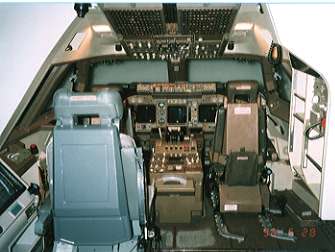
A display at the left of the back seat is a computer console for this
Simulator
By the way, I visited here with my friend Mr.Watanabe who will act as a
"cameraman", today. Mr.O who is working for JAL in the groud operation
is also with us. We all are three, going to board together. Mr.O worked
and helped us so hard to realize today's project, and will help us again
today, as an operator of computer console of the Flight Simulator.
Fortunately, The 747-400 has two extra seat in a cockpit, so we are right
on the seating capacity.
3. Data entry to the Flight Computer(CDU)
Finally, Capatain H came. He was smiling gently and said, "Sorry for
having you waited so long." I was so impressed, feeling "Oh, no! That's
too good for me to hear such a patient word!". Why all the Captains who
I met so far are so genlte? They all were so gentle, as much as a man
falls in love, as a man. I longed a Pilot again, understanding that maybe
that is a character coming out, only great men who have experienced and
passed severe trainings all the way could maintain. I exchanged name card
with him, vowing many times. We took off suits and put them in a cloak
which is set on the wall right back of the Co-pilot's seat. (I was happy
to learn that there is such a strcture, as such a little thing had never
be explained in magazines..)
Captain H said "Well, let's get seated, anyway." I took the Captain's seat
at the left, and he took the Co-pilot seat. I had an experience to get
seated the 747-400's Capain's seat before, but it is hard to simply get
seated as I have to watch out my head not to toutch the overhead console,
bending my back like a lobster, stopping breath. I know there are swithes
of motordiven seat adjustment system underneath the right side of the
seat. As I couldn't tell where exactly they were, I was in an unnatural
posture awaiting for the Captain's instruction.
I was asked by the Captain, "Well, to where about we should go?"
I answered to him without any hesitation, "How about taking off the Runway
-34L at the Heneda International Airport, taking course as Zama-3 depar-
ture, heading for Mt.Fuji...?" He said, "Oh, That's good idea, we can
fly over to Fukuoka, then." Wow! What an incredible suggestion! It'll
take one and a half hour at least! He is ready to come with me as much as
that! Well, That's a waste of time. I wanna try many more thigs today.
So, I said to the Captain, "After reaching Mt.Fuji, we'll make left turn
to fly over Tateyama, and then proceed approach to Runway34L at Haneda to
get back." He said, "Oh! That'll be fine! " Thus, our first flight
course has been decided. After all, I forced the way to my usual flight
course with my PC-Flight Simulator!
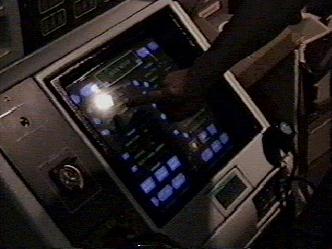
Mr.O set necessary conditions into the control CPU
of the Flight Simulator
Captain H has started to set the data of the enroute into the CDU (Control
Display Unit), which is mounted under the front instruments panel, upper
right of the thrust lever, with the forefinger like "Pittz, Pottz, Pattz"
My mouth fell open looking at his magical operations. He carries on doing
so pushing function keys(Item Selection Keys) at both side of the display
with Ten-keys and Alphabet keys.
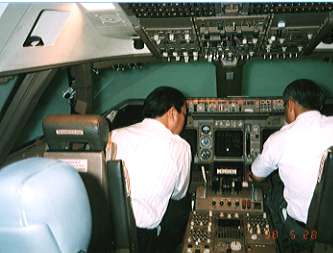
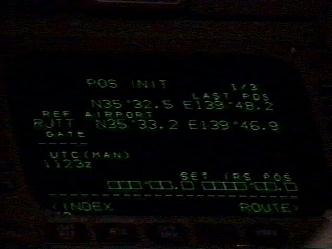
First of all, set the current position into the
CDU(Control Disply Unit)
Data input was started from the current position of the airplane in the
latitude and the longitude, which will be the origin of the IRS culcu-
lation. Their data for each spot of major airpots were already set in a
memory, and then, set was completed with just one touch operation. I said
"If we miss that, then another Korean-Air-Accident would come again, right
?" "That's right!", said Captain H. As Runway34R has been set in memory
of the CPU of the Simulator, we changed the departing runway as 34R from
34L. The 34R is the newest one which is located on the sea side of the
airport, and has ben opend since a year ago. That's a kind of sad as the
Microsoft PC-Flight Simulator does not have this new runway yet. I talked
to my self, "That's all right, I should just decend down to the runway one
more right as usual!", imaging the scenery of approach facing three run-
ways(33, 34L, 34R) ahead in sight.
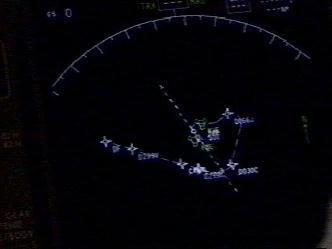
Weigh Points being set. The Autopilot system will
guide us according this setting.
4. Engine start
"Now, we are ready to start engines", said the Captain. He started to turn
on many switches one by one looking up overhead panel saying, "Actually,
we ask the tower the permission to start engines....". So many switches
he turns on! As I knew that the Jumbo had an auto-starter system, I
thought just a few steps would be needed to start engines. (At least,
switches as many as the numbers of engines.) So, I was really troubled to
understand what he's doing from the beginning.
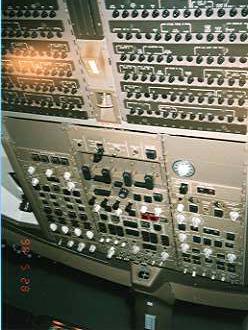
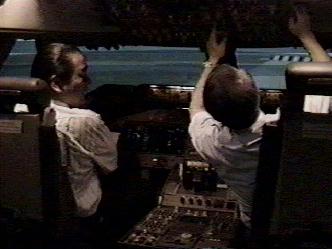
Fights against many switches on the overhead-pannel.
After a battle with swithces, the Captain picked up the "Before Start
Check List" from the top of the instruments panel console, and started the
all setting he has done one by one according to the list. Even if it's a
Simulator, he does it! I was really impressed by his proffesional syste-
matic operation.
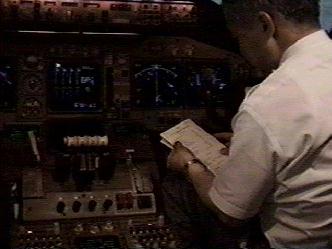
Confirming with a Checklist
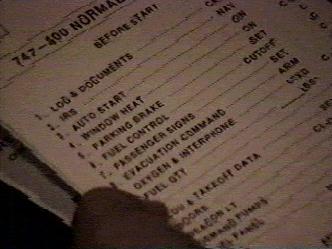
Before Start Check List
After fighting against many switches on the overhead console, the Captain
instracts me "Lift up the lever at the most right", switching on the
starter switch of the No.4 engine. Woops! Doesn't move! "Pull first,
and lift up." says the Captain. Oh, Yeah, all the lever type switches
are designed to be pulled first before lift it up to prevent to be opera-
ted without intention. I found myself having losted a major part of the
brain already. As the indicators of the power (in parcentage) and the
tachometer(each of two turbine shafts, N1 & N2) of the No.4 engine in
the EICAS display which is one of the six color displays rise, a familiar
sound of engine comes up. The body has started its vibration a little.
5. Set the seat position
After having started all engines, the Captain set his seat belt on and
started to adjust the position of the seat. As I was just watching him
and sitting vacantly waiting for his instruction, he taught me the where
the seat control switches are, and guided me to set the seat at he best
position looking at me form the side. "Is that much ahead?!" I was
surprised that I was guided so close to the front instruments panel.
The vertivcal position of the seat was also guided to much higher position
than expected. "Oh, What a nice view!!", I got quite agreed. The PC Fli-
ght Simulator has really poor front view being disturbed by the front
instruments panel, and sometimes that makes the approch difficult. But now
I understand that was not simulating a real flight. I felt I was relaxing
a little with this fantastic view.
The scenery out of the window is so nice. The scenery on the ground itself
is not as detailed as the PC Flight Simulator, however, for example,
runways themselves are much more real with this Simulator. It is amazing
to see the super quality bright and colored panorama view of 180 degrees.
The view is really wide and three-dimentional, and it is easy to under-
stand and grasp the position and situation of myself. People pay atten-
tion to the density and resolusion of the secenery, but I understand that
is because it is not in the three-demensional world.
Well, next, I try to set the seatbelt on, but I just can't pull the belt
out to get it longer. That is the same one as in automobiles, but it is
locked, and can't pull it out. The Captain says " Do like this...."
What a mess! What can I do being unable to do such a simple thing!....
As I get hurry, things seem to get more difficult. What a miserable man!
At last, Captain H asks me " Shall I sit your side?". Oh, No! No way!
This is a Captain's Seat! No way to change the seat!... I was shouting
in my minds the words which I never could shout in a voice, and clenched
my teeth fighting with the belt. Finally, the belt was released, and
the trouble was over. However, I wasted a good amount of energy already.
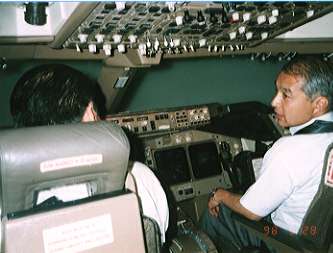
6. Taxi and Hold Short of Runway-34R
Everything is ready. The Simulator started with the the position at just
before the entrance of the Runway34R, on the taxiway, heading to the oppo-
site direction for the take off. " Well, step on the break firmly to get
the parking break released.", said the Captain. The parking break is a
little lever at the far left of the thrustlever, little below ahead the
floor. It is operable with just a forefinger to pull it upward. It's
amazing that such a little things works for a big body. As I step on the
break pedal with both feet firmly, the parkig break got released auto-
matically.
"Now, start taxing.", said the Captain. Calming down the high beating
heart, I streched my arm to grab the thrustlever. As I have a big hand,
I colud hold the handle of the thrustlever, fitting four fingers from a
forefinger to a little finger to the four hollows on the handle. The
Captain told me nothing about how much power I should add nor what would
be an adequate speed. I was calm enough to get remind that I should add
power slowly to get 15 to 20 knots at straight, and slow down to 10 knots
while turning direction. I made up my mind not to get the Captain dis-
appointed, and push the thrustlever ahead a little.
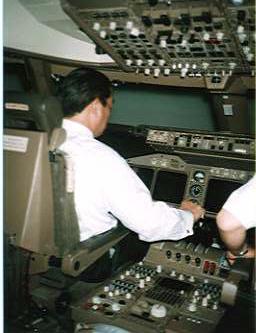
Oh! it moves! (That's for sure!!) Giant Jumbp started to move slowly, and
the vibration made from the surface of the ground is started to be felt.
I knew that for a big airplane, tiller with a similar shape of the emer-
gency break of the train or freight car is used to control the direction
of taxing in stead of rudder pedal. But, I was worrying about if I could
learn how much I had to turn, and if it's possible to control well with
the left hand.(Please note that most of japanese are right-handed person.)
The PC-Flight Simulator doesn't have tiller, anyway!! I tried it still
worrying about. Giant Junmo suddenly reacted to turn the nose with the
strong feeling of inertia and rolling. As I released the tiller from my
hand, the Jumbo being forced to change the taxing direction, got back to
go straight with strong force. Wow, That's good! Much easier than using
rudder pedal! "As the front wheel is not loaded with much weight of the
body, it's easy to slip when raining.", said the Captain. As the end of
the taxiway approaches, I turned the tiller to the left firmly, and com-
pleted "Hold Short of Runway34R".
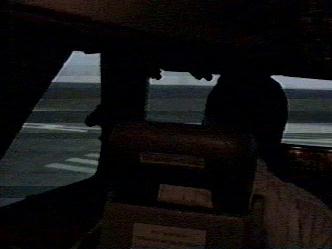
"Hold Short of Runway34R" completed.
I was checking the Runway to the takeoff direction in the left.
Outside view is just fantastic! That is not like movie in the plain
screen. As I put my face ahead to see the ground just below the nose
of Jumbo, I can see it. No gaps with a real senery.
With the Captain's instruction saying "Proceed go ahead", I turned the
tiller to the left once again to get completed alignning the Runway.
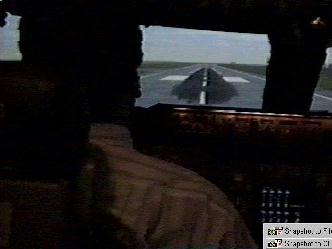
Aligned thje Runway
To work breaks, step on the very top part of the rudder pedals to tilt
them over ahead. As it's so powerful once it wotks, although it's heavy,
I stepped on strongly but gently, so that other people on board wolud not
get sick. The Flight Simulator simulates perfectly the reaction, falling
forward exactly the same as real one.
7. "Cleared for Take off Runway-34R"
"Lift up and push forward the thrust lever till it reaches to the vertical
position. As the auto-throttle has been set on, after you confirm the
the engine power increases(in the EICAS display), push down this balck
lever. Then, the adequate power is set automatically.", said yhe Captain.
What? What's that? I've never heard of that!! As he says, two black
levers are hidden in front of the thrust lever. Streched fore finger and
a middle finger can reach the top of the black levers to push them down,
holding the thrust lever. I learned these levers are so-called TO/GA lever
fo provide the "Takeoff" and "Go-around" later.
"Well, here we go. Cleared for Take off!", said the Captain, before I
could confirm the procedure. I lifted and pushed ahead the thrust lever.
Wow! Here it comes! My body was pushed back and sunk in the seat back.
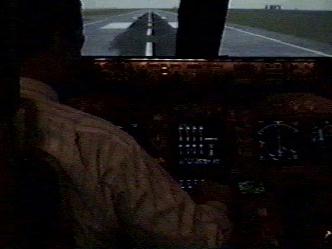
"Cleared for Take Off"
I understood that the Jumbo was a liitle bit off the centerline of the
runway, and adjusted the course using rudder pedals. This control was
successful despite under strong acceleration, as I have been practicing
this with the PC-Flight Simulator so many times. "Now! You can push it
down!" says the Captain. Oh, yeah, the auto-throttle! I pushed down the
black leve, and the system was on. The Jumbo continues its acceleration.
A real airplane has a very good tendency to go straight, and I don't need
to fight agaist the rudder pedal to keep the course straight like with
the PC-Flight Simulator. Seems I'll make it all right. ".....V1....V2..
.....VR! Now! Lift(Rotate) it!", says the Captain.
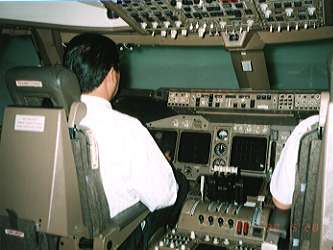
The centerline of the Runway 34R is ahead in the right window.
Although I had a backgroud knoledge that "Till the V1, one of the hands
should keep holding the thrustlever to make it possible to stop the air-
plane within the rest of the runway, and after reaching the V1, as there
would be no choice keep going or stopping, then the both hands should be
at the control yoke", I forget all about that and I jumped to the control
yoke right after pushed down the auto-throttle. I pulled the controlyoke
(Rotation), and the giant Jumbo lifted up the nose making a noise and
vibration of the wheel kicking the groud to take off. I was fixing my eyes
on the PFD(Primery Flight Display), imagining that the big box of this
Simulator is moving and leaning if I could see it from the outside.
I pushed ahead the controlyoke a little bit, according to the instruction
of the Captain saying "Keep the nose within 20degrees." Oh, it's heavy!
A real Jumbo asks us to use muscles to control in anything! The Jumbo are
getting air-speed in good order, and a takeoff was successful
8. Flight Control
After takeoff from the Runway34, we made a right turn (heading100), and
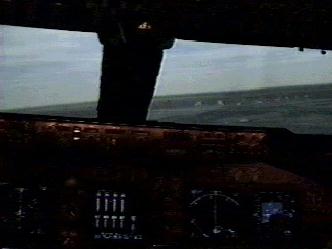
After takeoff, we made Right Turn.
keep going abut 10 miles. Then another right turn (heading 210) to see
Haneda Airport where we have just departed from on our right side, and
reach over Zama-city at flight level 190(19,000feet). Then adjust heading
to 268degrees(heading 268), and then Mt.Fuji will show up in front of us
in the left side, soon. This course will leads us finally to Nagoya city.
This pattern of departure is so-called "Zama3-Departure", which I have
experienced many times in a real flight on my businness trip to Kyushu
Island, as well as the PC-Flight Simulator. (There seem to be cases that
after the takeoff at Haneda, continue right turn to fly right over Haneda,
heading 270 to Zama, keeping the same heading direction all the way to
Nagoya.) After the takeoff, I was intending to check the radials from
VORs to control the heading direction, but the Captain said, "Control so
that white square should be tracked on cross in the PFD (Primary Flight
Display)". What?! A little white square right here ? I've never heard
of that! Isn't that a PFD is used for check the posture, speed and alti-
tude of the plane? And isnn't that the way that track the course by dis-
playing HSI(Holizontal Situation Indicator), DME(Distance Mesuring Equip-
ment) in the ND(Navigation Display)? I have not seen the PFD in the inst-
ruments panel of the 747-400 with a white square being displayed like this
in the PC-Flight Simulator! I was looking at the PFD being suprised the
new fact that I had not heard of before, and found there's a square about
2 milimeter square with a white line moving and leaving from the center
cross point.
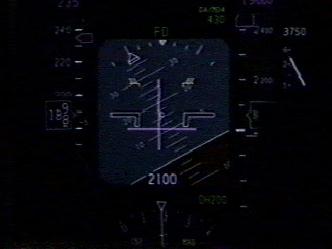
Track a "square" trying to move away with the cross
point in the PFD.
I concentrate with tracking the square controling the flightyork.
Of course, there is no time for me to take a look outside of the plane.
I was getting angry with myself that I had no way to check and avoid a
near-miss, but just concentrating with the control. Oh, yeah, the pre-
set informations being displayed in the ND with a map mode is relayed and
displayed in the PFD in this way....That's wonderful! I finally satisfied
with the matter. Every time to change the heading direction, the square
moves very fast to certain direction, so I have to move the controlyork
in one direction with with a vengeance.
"You have a nice and soft touch to cntrol!", the Captain gave me a comple-
ment at the first time. I have read an experience report in one aero-
nautical magazine about getting on a flight simulator of old 747, being
repoted by a reporter who has a license for small airplane, and ha an
oppotunity as a prize of saving "Mileage Saving Service". In the report,
he wrote "A big aricraft has a strong moment to control, and reacts very
with a time delay. As a result it's easy to control too much, and finally
it flew swerving back and forth." Well, I was lucky to be able to control
without any problem as I had quite a expeience fo the PC-Flight Simulator
with an old comuter with a 486 processor, getting acustomed with slow re-
actions. I had not much problem as I could predict the reaction of the
Simulator. I was happy with knowing the PC-Flight Simulator really worked
out.
9. Auto-Pilot
A little while later, I recognized that Mt.Fuji is ahead of us. "Well, we
go back now?" said the Captain. He streched his arm to control the nob of
the heading set of auto-pilot system at the glear-seald ( at above the
front instruments panel, a border between the window and the instruments
panel), and turned it to 180 degrees.(Set is available in every degree
making click noise) As he turned on the auto-pilot switch, the Jumbo
begun to list toward left and make left turn to the South. "Fly as you
like, using this." said the Captain. Oh, yeah, that's easy! I was not
surprised a lot as I had already learned and tried the auto-pilot with the
PC-Flight Simulator many times, however it was really somthing to see a
big and heavy Jumbo was easy to be controled moving bravely. After flying
toward the South for sometime, I turned the nob to 100 degrees making
click noise, and the Jumbo made a left turn toward Tateyama city at the
end of the Boso peninsula.
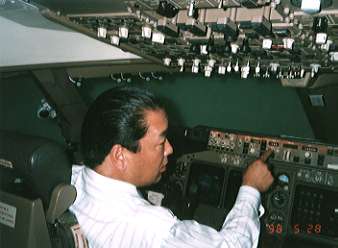
I was occupied with the memories of my business trip from the Kyusyu Is-
land on board a Jumbo Jet. At the rush time (6PM to 9PM), approach course
to Haneda Airport is really crowded, and many airplanes are making a line
like a chain. Sometimes, the airplanes are controled to go 90 degrees
left or right to adjust the separations, and also forced to descend down
in quickly or reduce the speed. When I first observed the spoilers on the
wing spread out to adjust the altitude quickly, I was really excited with
the terrible vibration caused by the spoilers resisting against air.
"Captain, May I use the spoiler now?", I asked. "Sure, You can do anything
as this is a Simulator..." he answered without any atmosphere of tension!
Is this a very unusual operation under this situtation? Well, I don't
care....This is a very rare chance for me, and I should try anything!
I tried to pull back the spoiler lever at the left of the thrust lever.
Woops! it doesn't move! "Lift it up first, then pull it back.", said the
Captain. Oh, yeah, I had to do so as same as other levers! Regular posi-
tion is not straight up, but leans ahead, so, for lift it up, I had to al-
most push it ahead, which is almost impossible action for me, as I had a
problem with my right shoulder just two weeks ago.(so-called "50 years old
shoulder" in Japanese) I shouldn't care however look I am! I used left
hand to support the action together with the right hand, to lift up the
lever, and finally, I could pull it back. Gu-gu-gu-gu-gu.... The body of
Jumbo started to vibrate with a familiar sound, due to the resistance aga-
inst the air by the spoilers spread out. The tempo of processing altitude
got much faster.
The Jumbo continue discending smoothly to 3,300feet, as the auto-pilot has
been set with the altitude mode. With the PC-Flight Simulator, I had been
spending hard time to control the power reducing air speed while descen-
ding, however, with the aouto-throttle system on, I do not toutch the
thrust lever at all. I was going to change the course to heading 360 when
we reach above Onjyuku-city. The Captain then asked me, "Do you have any-
thing that you would like to try?" I said, "Well, I'd like to try 'Engine
Fail'(Stop more than one engine while cruising)" "Oh, that's a good idea.
We'll do it" As we talke in this way, the Captain stretch his arm ahead,
and started to turn the nob of heading-set to change the heading. Oh, No!
I found the heading was set to 360 degrees. That's what I intended to do!
Geee...What a frustration!
10. ILS Approach
Heading 360, Altitude 3,000feet, Speed 200Knot. All what we have to do is
to wait for the Jumbo intercept the localizer of Runway 34R. My eys are
fixed on the PFD(Primary Flight Display) back again. Diamonds drawn with a
white line at the bottom and right end in the display turned into diamonds
painted all white. "Localizer captured!", said the Captain. ILS approach
has begun. I tried to control the control yoke so that a little square
drawn by white line follow the center of the cross, just the same as I did
after take off. This time, the control yoke gets heavy as the Jumbo lose
the altitude. "We are descending, and it's getting heavier. So, set adn
increase the trim.", said the Captain.
At the portion of the control yoke where the left thumb toutches, there is
a flat switch lever, and just by pushing it up or down, the stabilizer is
easily set and adjusted. As long as I push it up or down, the trim motor
seems to work continuously, and the operation feeling is just fine.
As I watch the commercial video of All Nippon Airway's Boeing747, after
the landing, while it's still on the runway giving breaks, the Pilot re-
peats turnig a nob of stabilizer making a click noise many times, with
his thumb. So, I thought it should be turnable with a click, however,
the newest Jumbo, 747-400 has an electric switch system for the stabilizer
adjustment, and is adjustble by just pushing it up or down, everytime the
control yoke gets heavy (feel reaction towards backward or forwarad) till
the force is not felt from the control yoke.
As I took a look ahead, I found Kizarazu city right below, and found the
Runway 33, 34L, and 34R of Haneda Airport is in sigt well ahead of us be-
yound the Tokyo Bay. Approach lights aligned runways are illuminating
saying "Come on! Come on!" That is a lovely familiar view, and feel con-
fortable everytime I saw it. Only the thing I felt new is the Runway 34R
which has not be included in the PC-Flight Simulator. This was all that
I clould take a look outside, as I have to concentrate with a display of
the PFD. fighting aginast the control yoke.
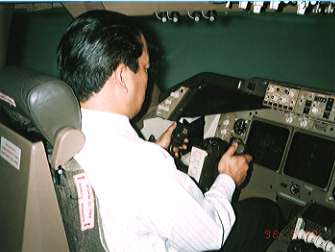
"Well, I'll set the flaps down", said the Captain. "All right!" "I'll
set the gear dwon, too" "All righ!", I was replying just by words with-
out thinking what he had said. I did not have any capacity with which I
could think and confirm the spread angle of the flaps, as I was concent-
rated with following the ILS. However, I could feel something strange
that I was feeling only little reaction from the given flaps, maybe be-
cause the flaps spread out is a little or the motors drives the flaps to
spread out little by little. (The PC-Flight Simulator spread out the flaps
at once as I push a function key.)
I was following the ILS very well, more than I expected. With the PC-Fli-
ght Simulator, I had experienced and learned to track and follow the ILS
the cross needls system on Cesna(A horizontal needle for the Glide-slope,
and a vertical needle for the Localizer.), and another system for 747 that
overlay moving parallel bar on the HSI for localizer, with keeping the
postition of a small diamond mark, moving up or down in the right side of
the monitor, in the middle. They all are really difficult to track acu-
rately. However, this system on 747-400 is really super, and is intuitive
and the movement for two directions in three-dimensional space is well
controlled with single view point in two-dimensional monitor. I was quite
satisfied with the perfect tracking to the ILS, and I was feeling that I
should praise myself. The Captain repeats "Good!"
While I am tracking to the ILS like this, the Captain says, "I will spread
the flaps more". "All right!" I was concentrating to the spot too much,
and I almost lost the feeling wether if I was moving a little square, or
the cross point, and the square started to move away from the cross.
"Woops!" I had to give a counter action to the control yoke. The square
came back to right on the cross, and never tried to leave there. The Jumbo
was keeping a good posture. "You'd better take a look outside once in a
while", said the Captain. Oh, yeah, I have been without looking outside
at all! As I took a look ahead, there was the Runway34R right close to
us. We are right on course to the runway!(It should be!)

Runwayy34R ahead, and the 34L at left. Super three-dimensional view.
11. Landing
"Set the power at the 65%", said the Captain. As I looked at the disply
of EICAS, which is set in the middle between us, the display showed that
the power is at about 57%. I pushed the thrust lever ahead a little to
get the 65% of power. "I don't like to loose the speed less than I have
set here.", said the Captain indicating the speed shown in the PFD. The
speed is reduced to 150 knots! I found a mark is set at 145 knots, right
below there. I understood the minimum speed (stall speed plus alpha) was
indicated there.
I recognised that I have been controling the altitude only by adjusting
the pitch(up & down of the nose) with the control yoke. With the PC-
Flight Simulator, especially on Cesna, under the approach procedure, I
used to control the altitude with power adjustment, control the speed with
pitch adjustment.... Is it because I did'nt recognize the small adjustment
on the throttle lever by the Captain, as I was concentrated with looking
at the PFD? Maybe that's because the Captain has been spreading the flaps
little by little with a good interval to kill the speed well, after setting
the power at an adequate level. Anyway, the Jumbo seems to go keeping a
speed reflected from the power setting. The speed itself is as twice as
that of Cesna at approach, and the body is much larger, then its behavier
and way to control is very different.
"One thousand(feet)!" Suddenly, the radio altitude meter read out the
altitude with a synthesized human voice. Oh! It comes! With this synthe-
sized voice read-out, I got a strong feeling that we have got into from
where we can never get back. "Nine hundreds!", the radio altitude meter
is still reading out the altitude, but it doesn't catch my ears anymore.
I can see the runway in sight, and I am standing by with full attention
already! I don't need any assist like that!
"At toutch down, automatic break will work", said the Captain. All right,
then, at the same time as the wheels toutch down to the runway, all the
spoilers will be spread at full angle, and the break will be kicked with
the full power, however, only the thrust reverser should be operated manu-
ally. Untill I had started the flight, I was brave enough to say that I
would control everything including power control till I would complete the
landing. However, I found myself thinking "Who said so?!". I have no way
other than concentrate in folowing the ILS and ask the Captain all the
things else.
Runway is right over there. We are just alignning the center line. It is
as well as I believe that I had never done with PC-Flight Simulator.
A little square in the PFS is right on the center of the cross. It is
obvious that the Jumbo could complete landing procedure automatically if
the groud facility is good enough for that. "Take aim at the white mark
on the runway to toutch down.", said the Captain. Take aim?!! No way.....
Oh, it's coming up. Toutch down is right over there. We are aligning the
center line . I'll flare(pull up the nose) just before the toutch down.
"Pull the control yoke, just before the toutch down. A little bit. About
one degree.", said the Captain. "All right!" Here we go! I gave it flare.
"Pull it more!", said the Cpatain. Can I pull it up as this much? Didn't
you say just one degree? It could be climbing as this posture! (Though it
is impossible to climb with this speed.) When I shouted in my mind so,
the sound and vibration of the wheels toutching down the runway was trans-
fered to me. Toutch down!!
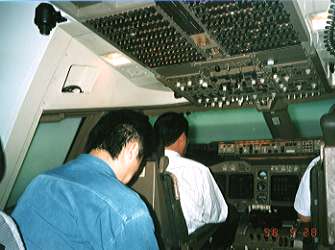
As the Captain pulled thrust reverser, the Jumbo break itself strongly
with a big jet sound, giving us a heavy G toward ahead. Using break
peddals on top of rudder peddals, the Jumbo finally stopped gently. Uh,
Uh, Uh.....As the voice, which couldn't be any word and could be under-
standable as sobbing or sigh of excitement escaped from my mouth, I
recognized that a white shirts I wore so that it shouldn't be strange in a
pilot seat was drenched with sweat.
12. Take off for the next Training Flight
It was short after that I was feeling that I could choose death with the
satisfaction that I could have experienced a dreamful full set of training
like engine start, Taxing, Take off, Enroute, ILS approach, and landing.
Captain H., who is like a God started to set the CDU(Control Display Unit)
for the next flight course. Ay! Incredible! Could it be happen really?
This time, after I took off runway 34R, I could have a chance to challenge
engine fail(flight with more than one engine stopped), as I had requested.
After I achieved level flight at adequate altitude, I recognized that
there was no ball-indicator which indicates if the body is slippong or
skidding. The Captain told me that a little triangle and a square being
touched to the base of triangle at the upper center edge of the PFD is
the one whichworks as a ball-indicator. If the aircraft star skidding
or slipping, a square being hang down the base of triangle starts to
move toward te right of the left, said the Captain. Wow, Is that right?
I got it. I was impressed that everything is indicated in the displays
in the B747-400.
Well, now, it's a time for engine fail. I pulled down the one of the
sour thrust levers to have the No.4 engine to be idling. Unexpectedlly,
there was not sudden reaction. However, the Jumbo started to tip down the
right wing slowly. As I looked the isntrument which I have just learned,
a small square, being hang down from the base of a triangle at the top
center of the display, started to drift to the left keeping the top side
toutched to the base of a triagle. I step on the rudder peddal with the
left foot, as I had already learned with the PC-Flight Simulator. Woops!
It's heavy! Jumbo demands us a strong power to operate anything! As I
to operate rudder, a square stopped to drift to the left more, and started
to return to the original position to the right. I adjusted so that a
whole top side of a square would be just on the wohle base side of a tri-
angle(original position) using rudder peddals. Due to the KANSEI, every
reaction of Jumbo is slow, and that's easy for me to control in comparison
with Cesna, which reacts too sesitve against control of rudder peddals.
With a control of the rudder, I could cancel and adjust the imbalance of
the thrust power between both wings, however, the Jumbo is still tipping
the right wing down. With this posture, the Jumbo keeps turning to the
right, although it could compensate the slip or skid. So, I turned the
control yoke to the left to have the Jumbo to get back to the level. Now
the Jumbo has got back to continue to fly straight. I learned one engine
fail would never be a serious problem.
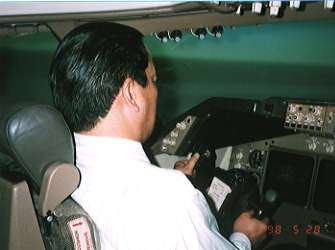
Anyway, the left leg being streched to step the left rudder peddal is
really hard. The Captain finally advised me, "You'll be comfortable with
rudder trim". He streched the left hand to the backward to reach to the
big rudder trim control nob at the back end of the center-pedestal to com-
pensate tthe force to the rudder. Wow! it's comfortable now! I felt as
if I had given an injection by doctor. I knew where the rudder trim nob
was, but there was no way to stretch my hand to the thing being placed at
the right backward that I couldn't see, while I was whole concentrating
with the things happening ahead. "Well, stop the engine completly.", said
the Captain, and turn off the switch of the fuel pomp for the engine No.4.
Not much difference than before.... In the next moment, he pulled back the
thrust lever for the No.3 engine. Wow! It's comming! The jumbo started
to roll and tip the right wing down widely again. The ball-indicator
started to drift toward the left. I put strong force on my left foot to
step the rudder peddal. It's heavy! As a gentle Captain adjust the ru-
dder trim, the tension was eased. I operated the control yoke to the ri-
ght, and was achieving a straight flight! Wonderful! Despite having lost
two engines on the right wing, it flys satably, with only two engines of
the left wing. I couldn't help saying "It flies perfectly!". " Well, it's
OK up here, but the a panic should be going on on the ground.", said the
Caaptain. According to his story, there was no real engine fail problem
in JAL's history, however, there happend the problem one time in a trai-
ning flight many years ago.
After this trial, we got back to the Runway34R. As it was the second
landing, I could give it a sufficient flare(lift up the nose). After the
toutch down, I could try to use a thrust reverser also.
13. Take off again, for the Last Training Flight!
After the landing, "What we should do next?", asked the Captain. "Wow! Can
I do it more? Isn't it a time-up?" I was all impressed with the Captain
as he tries to faced to me despite that it has passed nearly one and a
half hours. "That's all rigt!", said the Captain. "Well, if you say so,
let me try again!", feeling so sorry and incredible. To tell the truth,
I was already tired up by this moment, howevery if I loose this chance, I
would never have a chance again! As long as the Captain accompany with
me, I'll continue flying! So, I asked him for approach training. "Shall
we start from somewhere around kisarazu?" "All right, No problem." The
Captain instructed Mr.O, who is in charge of simulator setting today, how
to set, and have the Jumbo started from above Kisarazu. Thus, I started
approach to the Runway34R. This was the third approach, and the ILS app-
roach was really acurate and smooth. The trim control was also well done.
Keeping align the center of the runway, we were almost reaching to the end
of the it. This time, the posture for toutch down is good and perfect.
"Now, cut it!", said the Captain. Cut it?? Cut the flight yoke? What?
In the next moment the Captain strech his left hand to the thrust lever to
push it ahead all the way, saying "Go around!" Oh, I got it! As I was
controling and achiving a perfect approach,(I'm joking!) the Captain bel-
ieved that I would do everything, while I thought the Captin will control
the power at final approach just like he did former two approaches.
The "Cut it!" meant cut the POWER. I was going to know, how this result
was regretable soon! The final approach this time, was so perfect. The
flare was good, and I was right on course to the correcct landing point on
the runway. All I had to do for the perfect landing was just cut down the
thrust lever, that's it!!
Why was it a regretable result? The reason was going to be revealed in
the 4th approach after this go-around which was a closing of today's big
event. I had used almost all of the phisical strength and power for con-
centration by this time, after nearly two hours training. The gentle Cap-
tain seemed to have sympathy for me feeling so regret for what I have
done, and said "Let's try again!". He flew the Jumbo to above Kisarazu
city making shortcuts with high speed. Well, now, I have to respond with
a good result for his kindness. I started to the fourth approach to the
Runway34R. Everything is fine. I contoroled it without any problem to
just before the runway exactly follwoing to the ILS. I was aligning the
centerline of the runway perfectly. Now, give it a flare. I had to pull
the control yoke with my left hand, while I had to pull back the thrust
lever with my right hand right to cut the power after that. That'll be a
one-hand-drive, left hand to control yoke and right hand to the thrust
lever.
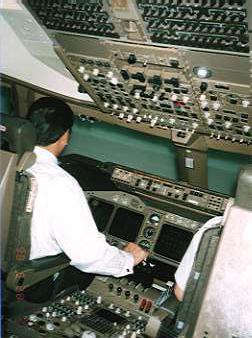
I pulled the control yoke wiht my left hand. Now, I'll pull back the
right hand. Just when I tried to pull back the thrust lever with my
right hand, the left hand which had been all tired up moved a little bit,
and as a result, the Jumbo tip the right wing down at just a couple of
meters high above the runway, and it slipped off the center line of the
runway! I was surprised and freezed in that short moment, shouting
"Oh! What a mess!" in my mind. The Captain understood what happened with
me suddenly, and control his control yoke at once to have the Jumbo get
back to correct posture.....The Boeing 747-400 which I flew, had toutch
down on the ground and continue running on the ground crossing the runway
diagonally from the right to the left slovenly. It stopped at far out of
the runway. And that was the moment of closing of today's training.
14. Thanks a lot, Captain H !
I understand that everything is over, and told the Captain "Thank you so
much!" from deep in my heart, and also, announced the closing of the trai-
ning. I found more than two hours has been passed. I couldn't stop feel-
ing "What a happy man I am!".
Although this is a simulator, we can't stop whole the thing with just
turning off some switch. Jumbo's simulator never stops without stopping
engines, and operate many switches according to the correct procedure.
I was surprised to see that at this point, the Captain started to confrim
his operations, picking up the check list and read it form the beginning
one line by one line. At the very final, there came my turn. "Parking
Brake", he read. The parking break was located on my side, and it was
still released. I was not instructed to do so, but I suddenly said,
"All right !", and pulled it up with the forefinger. That was absolutely
only one little thing that I could help the Captain today, as a man who
sat on the captain's seat.
Everything was over! Now, we can leave the cockpit. I drove back the
motor driven seat, turned myself to backward, and stand up from the seat.
But, in the next moment I felt down on my knees to the floor. Heavy!
My legs were so heavy as an iron. My body is drenched with sweat. My face
seemed to swelled up with fatigue. Oh, yeah! Even real trainees said to
be whole tired out after 2 hours training! I could have done well as an
amateur!
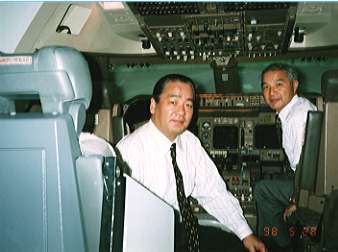
Gentle and kind Captain H, and me tired out and drenched with sweat.
After we got off the Flight Simulator, we took a memorial pictures with the
Captain, as the last job. Now, the time to leave came. I was fulfilled
with the thanks and awe for his patient despite the considerable fatigue
after his proper job. He had been attending to me keeping calm, gentle,
kind, and honest all the time through the training. I think I learned
that a professional airline pilot is professional not because of his high
knowledge and technique, but becasue of extraordinary humanity which su-
pports them. And, that super humanity gives precise and adequate judg-
ment under any kinds of severe situation or environment, so that he can
fly safely and securely. I was so sure that when I try to make the dream
come true to be an airline pilot in the next world, the largest problem
would be my humanity.
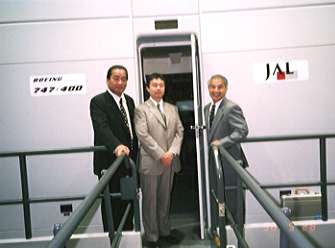
Captain H, Mr.O, Thank you so much!!
 Thank you note for Captain H. Thank you note for Mr.O of JAL, who had
worked so hard to realize today's project, and for Mr.Watanabe(JR7LNP),
who had introduced me his friend Mr.O and taking pictures as cameraman
in the Simulator. I do appreciate that you all have my dream come true!
(With out a goodwill and help of my friends, I had never achieved either
the first flight on Cesna about a year ago, or the project of this time)
Thank you note for Captain H. Thank you note for Mr.O of JAL, who had
worked so hard to realize today's project, and for Mr.Watanabe(JR7LNP),
who had introduced me his friend Mr.O and taking pictures as cameraman
in the Simulator. I do appreciate that you all have my dream come true!
(With out a goodwill and help of my friends, I had never achieved either
the first flight on Cesna about a year ago, or the project of this time)
Answer FAX from Captain H. to my Thank you note and a copy of this web page.
 In case you hit this
page directly from a Search Engine, you can reach to all of the pages of MAFNET from Top Page
In case you hit this
page directly from a Search Engine, you can reach to all of the pages of MAFNET from Top Page